
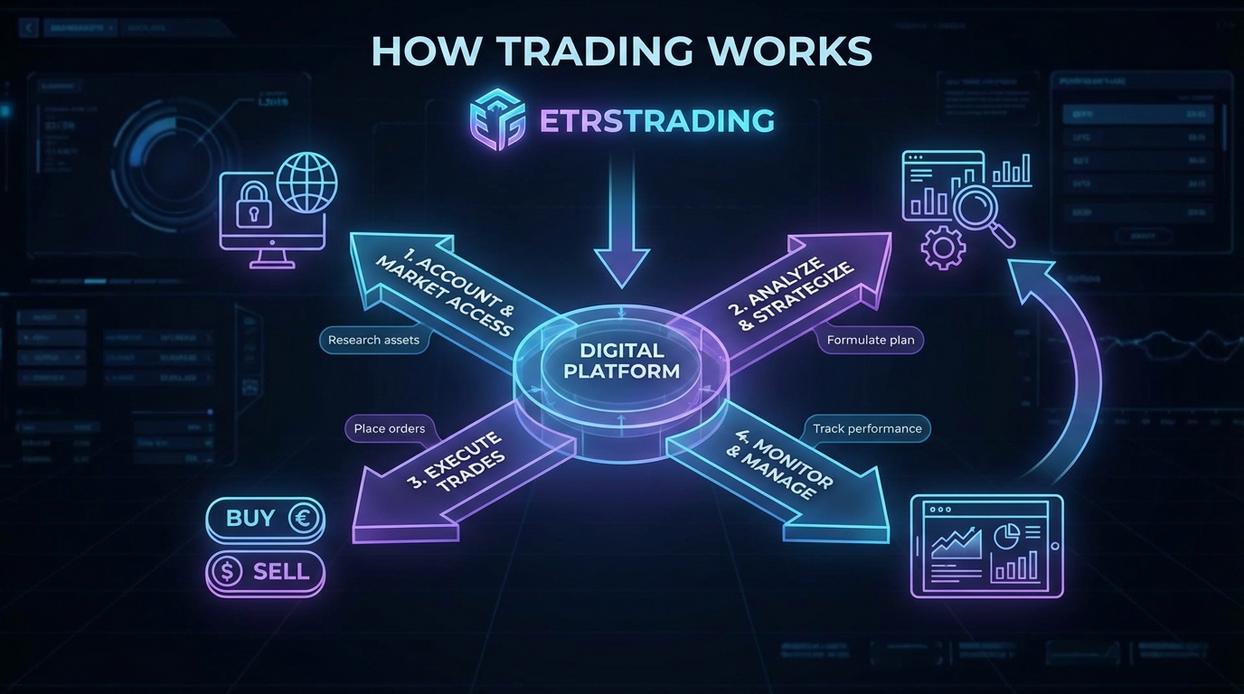
I’ve seen too many traders jump from strategy to strategy, chasing results they never quite catch.
You’re probably here because you want a system that actually works. Something you can follow without second-guessing every decision or letting fear take over when the market moves against you.
Here’s the reality: most traders fail because they don’t have a framework. They react instead of respond. They guess instead of analyze.
ETRS Trading gives you structure where there was chaos.
This article breaks down exactly how the system works. I’ll walk you through the mechanics, the signal analysis, and the risk management principles that keep you in control.
We focus on systematic approaches that remove emotion from your trading decisions. The kind of discipline that separates consistent traders from everyone else.
You’ll learn how to identify signals, when to enter a position, and how to manage trades once you’re in them. No guesswork. No hoping the market does what you want.
By the end, you’ll understand the complete framework and how to apply it to your own trading.
What is ETRS Trading? Core Principles Explained
Let me break this down for you.
ETRS stands for Entry, Target, and Risk System. It’s a rules-based framework that takes the guesswork out of trading decisions.
I know what some traders will say. They’ll tell you that rigid systems kill your ability to adapt. That the best trades come from gut instinct and reading the room.
Here’s my take on that.
Sure, intuition matters. But how many times has your gut feeling cost you money? (I’ve been there more times than I want to admit.)
The whole point of ETRS is to remove emotion from the equation. You focus on three things: high-probability entry signals, pre-defined profit targets, and non-negotiable risk controls.
The Three Pillars That Make It Work
Momentum & Signal Analysis comes first. You trade with the market’s direction, not against it. Technical indicators validate your entry points before you put money on the line.
Think of it like surfing. You don’t paddle against the wave.
Proactive Trade Planning means you decide everything before you enter. Your profit target? Set. Your stop loss? Already determined. No scrambling when the price moves.
Risk Management is where most systems fall apart. ETRS makes it non-negotiable. Every single trade follows the same risk protocols. No exceptions when you’re feeling confident.
Here’s how trading works Etrstrading in practice. You spot momentum building in a stock. Your indicators confirm the signal. You enter at your predetermined level, set your target at 5% profit, and place your stop at 2% loss. Then you wait.
That’s it. No second-guessing. No moving your stops because you “feel” different about the trade.
The Mechanics: A Breakdown of ETRS Components
Most trading systems sound great until you actually try to use them.
You open the chart and realize you have no idea where to enter. Or worse, you enter at the right spot but have no clue when to take profits or cut losses.
That’s where ETRS is different.
Some traders argue that mechanical systems take away your edge. They say the best trades come from gut feel and reading the tape. And sure, experience matters. I won’t pretend it doesn’t.
But here’s what that argument misses.
Without a system, you’re just guessing. You might get lucky a few times, but eventually the market will hand you a loss that wipes out weeks of gains.
ETRS breaks down into three parts. Each one handles a specific job in your trade.
E is for Entry
This is where you get in. But not randomly.
I use a confluence approach. That means waiting for multiple signals to line up before I pull the trigger. Think moving average crosses combined with momentum oscillators like RSI. When they agree, you’ve got a high-confidence setup. By employing a confluence approach similar to the strategies used in Etrstrading, where multiple signals converge to create a high-confidence setup, you can significantly enhance your decision-making in the gaming market. By employing a confluence approach similar to the strategies used in Etrstrading, traders can significantly enhance their odds of success by waiting for various indicators to align before making a move.
One signal alone? That’s noise. Two or three together? Now we’re talking.
T is for Target
You need to know where you’re going before you start the trip.
I set profit targets using risk/reward ratios. Usually 2:1 or 3:1. That means if I’m risking $100, I’m aiming to make $200 or $300. Sometimes I’ll use Fibonacci extensions or major support and resistance levels instead.
The point is simple. Your target should make sense based on what the market can actually give you.
R is for Risk
This is the part that keeps you alive.
Stop-losses aren’t optional. I set mine based on market volatility using Average True Range (ATR for short). When the market is choppy, I give trades more room. When it’s calm, I tighten up.
Position sizing matters just as much. No single trade should wreck your account. I keep each position small enough that even a full loss won’t hurt.
That’s how trading works etrstrading style. Entry gets you in at the right time. Target tells you when to cash out. Risk protects you when things go sideways.
Each component does one job well. Together they form a system you can actually follow.
The Process: A Step-by-Step Guide to an ETRS Trade

You might be wondering how trading works etrstrading when you’re actually sitting in front of your screen with real money on the line.
Fair question.
I’m going to walk you through the exact process I follow for every ETRS trade. Not the theory. The actual steps from start to finish.
Some traders will tell you that systems are too rigid. That you need to feel the market and trust your gut. They say following a process kills your edge.
Here’s why they’re wrong.
Your gut is what gets you into trouble. It’s what makes you chase a stock that’s already run 20% or hold onto a loser because you’re sure it’ll bounce back. A process keeps you disciplined when emotions want to take over.
Let’s break this down.
Step 1: Pre-Market Preparation
I start before the opening bell rings. I scan for assets that show the right momentum and volatility patterns. This gives me a focused watchlist instead of trying to watch everything at once (which never works).
The benefit? You’re not scrambling when the market opens. You already know what you’re watching.
Step 2: Signal Identification and Validation This connects directly to what I discuss in Trading Guide Etrstrading.
Now comes the hard part. Waiting.
I monitor my watchlist for a valid ETRS entry signal. The key word is valid. Not almost valid. Not close enough. You need confirmation before you risk a dime.
Most losing trades happen because someone jumped in too early.
Step 3: Trade Execution and Order Placement
Once I get confirmation, I execute. This means placing three orders at the same time. The entry, the stop-loss, and the profit target. All linked together.
Why three orders? Because you’re deciding your risk and reward before emotions get involved. Check out the etrstrading trading guide by etherions for more on order setup.
Step 4: In-Trade Management
Here’s what nobody tells you. The trade isn’t done once you’re in.
I actively manage the position. Sometimes that means moving the stop-loss to break-even once the trade moves in my favor. Other times I use a trailing stop to ride a strong trend without giving back too much profit. As I navigate the complexities of trading, I often find myself relying on insights from resources like the Coinbase Wallet Review Etrstrading to enhance my strategies and optimize my risk management. As I navigate the complexities of trading, I often find myself relying on insights from various resources, including the recent Coinbase Wallet Review Etrstrading, which provided valuable strategies for effectively managing my positions.
This is where you protect your gains.
Step 5: Post-Trade Analysis
After I close the trade, win or lose, I log it. Every single one goes in my journal.
This step separates traders who improve from those who repeat the same mistakes forever. You need to see patterns in your execution. What works. What doesn’t. Where you keep screwing up.
The process isn’t glamorous. But it works because it removes the guesswork and keeps you consistent.
Common Pitfalls in ETRS and How to Avoid Them
Most traders blow up their accounts the same way.
They don’t lose because the market is rigged or because they picked the wrong system. They lose because they make the same three mistakes over and over.
I see it all the time. Someone learns how trading works etrstrading and gets excited. They nail a few trades and suddenly think they’ve cracked the code.
Then reality hits.
Signal Chasing: When Good Enough Isn’t Good Enough
Here’s the first trap. You’re watching the market and you see something that looks close to your setup. Not perfect, but close enough.
You convince yourself it’ll work out. You enter the trade anyway.
That’s signal chasing. And it kills accounts faster than anything else.
The system gives you specific criteria for a reason. When you start bending the rules because you’re bored or impatient, you’re not trading your system anymore. You’re gambling.
The fix is simple but not easy. If the setup isn’t there, you don’t trade. Period.
Some traders argue this approach is too rigid. They say markets are fluid and you need to adapt in real time. But that’s missing the point. Adaptation comes from refining your system over time, not from making it up as you go.
Ignoring Risk Parameters
The second mistake happens when a trade goes against you.
Your stop-loss is sitting there. You know you should exit. But you tell yourself the market will turn around if you just give it more room.
So you move the stop. Just a little bit.
That’s how small losses become account-ending disasters. Your initial stop-loss isn’t a suggestion. It’s the maximum amount you’re willing to risk on that specific trade.
When you ignore it, you’re throwing out the entire risk management framework that keeps you in the game. (And trust me, staying in the game is half the battle.)
System Hopping After a Few Losses
The third pitfall shows up after a losing streak.
Three losses in a row and suddenly your system feels broken. You start looking at other strategies. Maybe something with higher win rates or different indicators.
But here’s what you need to understand. Every system has losing periods. Even the Coinbase Wallet Review Etrstrading shows that consistent execution matters more than perfect timing.
The solution is to zoom out. Look at your system over 50 trades, not five. Focus on following your rules consistently instead of chasing the perfect strategy.
Achieving Consistency Through a Systematic Process
You came here because your trading results are all over the place.
One week you’re up. The next week you’re down. The pattern repeats and you can’t figure out why.
I built ETRS Trading to solve exactly this problem.
Most traders fail because they let emotions drive their decisions. Fear kicks in at the worst time. Greed makes you hold too long.
The ETRS framework replaces that chaos with a rules-based plan. You follow signals instead of gut feelings. You manage risk before you enter a trade (not after you’re already losing money).
This works because it integrates signal analysis with mandatory risk management. You’re not just chasing setups. You’re protecting your capital at every step. For players looking to enhance their trading strategies while safeguarding their investments, the Etrstrading Trading Guide by Etherions offers invaluable insights that seamlessly blend signal analysis with essential risk management practices. For players looking to enhance their trading strategies while safeguarding their investments, the Etrstrading Trading Guide by Etherions offers invaluable insights into combining signal analysis with effective risk management.
Here’s the thing about consistency: it comes from repetition and discipline.
You now have the blueprint. You understand the mechanics and the process.
Your Next Move
Start with paper trading or a simulator.
Run the ETRS process without risking real money. Build your confidence through repetition. Track your results and watch the consistency develop.
Once you see the pattern working, you’ll know you’re ready for live markets.
The framework is designed for long-term capital preservation. That only happens when you trust the process enough to follow it.